
MetaDynamic / Enterprise AI solution story
Enterprise AI Copilot.
Ask. Understand. Decide.
Ask a business question in Microsoft Teams. See a clear answer, supporting sources and relevant analysis—through an enterprise AI blueprint built around approved knowledge and governed access.
Knowledge-first pilot design, with a wider roadmap for business-system queries and analytical responses.

Watch / 85-second solution film
See the copilot
in action.
From a question in Microsoft Teams to an answer grounded in approved evidence. Follow the journey through Copilot Studio, Azure AI Search and Azure OpenAI.
- Ask naturally. Review the answer and its source.
- Understand access filtering and the evidence fallback.
- See how a governed analytics roadmap could extend the pilot.
Solution blueprint. Chat screens are illustrative; the analytics use sample data. Wider system integrations remain a roadmap.
English narration and on-screen captions · 1 min 25 sec
Watch the widescreen film on YouTube ↗
Read the film transcript
00:00 — The business question. A policy in one repository. A process in another. And the answer, spread across systems and teams. What if you could simply ask? This is MetaDynamic’s Enterprise AI Copilot blueprint. Ask. Understand. Decide.
00:15 — Ask in Teams. It starts in Microsoft Teams. Type a business question, the way you would ask a colleague.
00:23 — From question to evidence. Here is what happens next. Copilot Studio orchestrates the request. Azure AI Search retrieves approved evidence, filtered by your access. Azure OpenAI writes an answer grounded in that evidence. And it returns to Teams, with its source.
00:38 — Review and follow up. You see a clear answer, and the document behind it. Check that the source applies, then ask a focused follow-up.
00:46 — When evidence is missing. No approved evidence? It says so, and points you to the content owner. The knowledge pilot is read-only, by design.
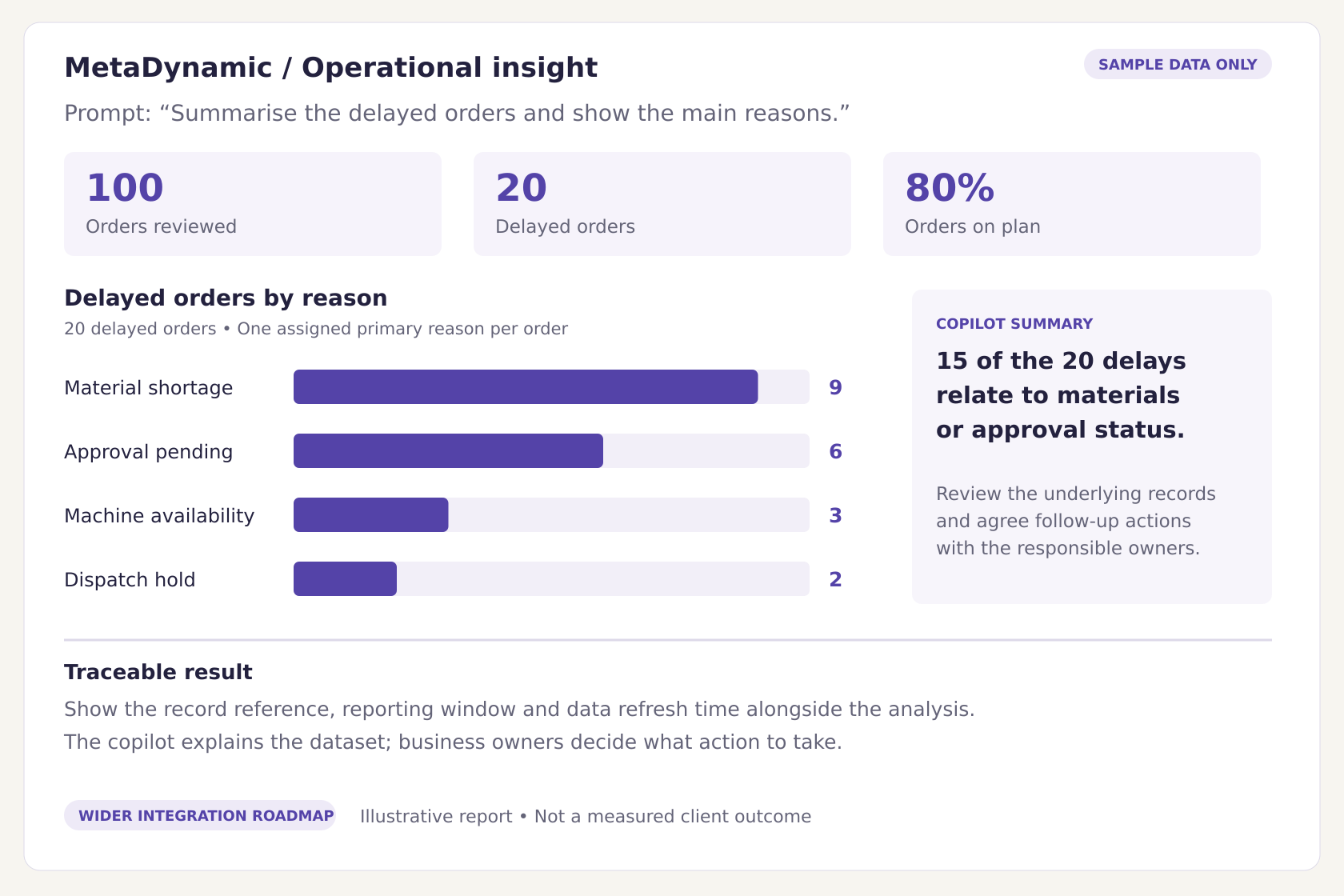
00:54 — The wider analytics roadmap. On the wider roadmap, approved data from SAP, CRM and HR adds analysis. Ask for the pattern. See the reasons. In this sample, materials and approvals explain fifteen of twenty delays.
01:08 — Govern the response. Every response should make three things clear. What is the source? Who can see it? And what needs human approval?
01:15 — Define the pilot. Start with a bounded pilot. Define, validate, then decide. Choose one business question worth answering well. metadynamic.in.
The business challenge
Good answers should not depend on finding the right person.
A policy in one repository. A process in another. An operational answer spread across systems and teams.
Manufacturing organisations depend on information held in ERP, CRM, HR platforms, shopfloor systems and everyday documents. Finding the right source can mean switching applications, following email trails and asking colleagues to interpret the result.
MetaDynamic’s Enterprise AI Copilot approach defines a conversational entry point with clear boundaries: retrieve approved evidence, respect the user’s access and make the source of an answer visible.
Make knowledge accessible
Bring selected policies, SOPs and process documents into a scoped knowledge experience.
Connect the context
Design routes to specialist business domains and distinguish source facts from explanatory guidance.
Keep people accountable
Define content ownership, access rules, escalation paths and approval gates before expanding the pilot.
System topology / Knowledge first
From a business question to an answer with a source.
The logical topology separates the user experience, orchestration, retrieval and language-model response. Retrieval-augmented generation (RAG) uses approved evidence to ground the answer.

The operating rule: if approved evidence is missing, the agent should say so and direct the user to a content owner. The knowledge pilot is read-only.
The user experience
From a typed question to a useful response.
A meaningful enterprise chatbot does more than return a paragraph. It makes the question, evidence and next step easy to understand.
In the knowledge pilot, the response is a concise explanation grounded in approved documents. In the wider integration roadmap, approved business data can support summaries, tables and charts.
- Enter the questionType naturally in Teams and add a process, location or time period when needed.
- Review the evidenceSee the source reference and check whether the document or record applies.
- Understand the resultRead the explanation, explore the analysis and ask a focused follow-up.
Analytics / Wider integration roadmap
Ask for the pattern. See the reasons.
“Summarise the delayed orders and show the main reasons.”
This illustrative report turns a bounded dataset into a count, a visual breakdown and a short explanation. In a deployed integration, the reporting window, data freshness and record references must accompany the result.
Knowledge graph / Information relationships
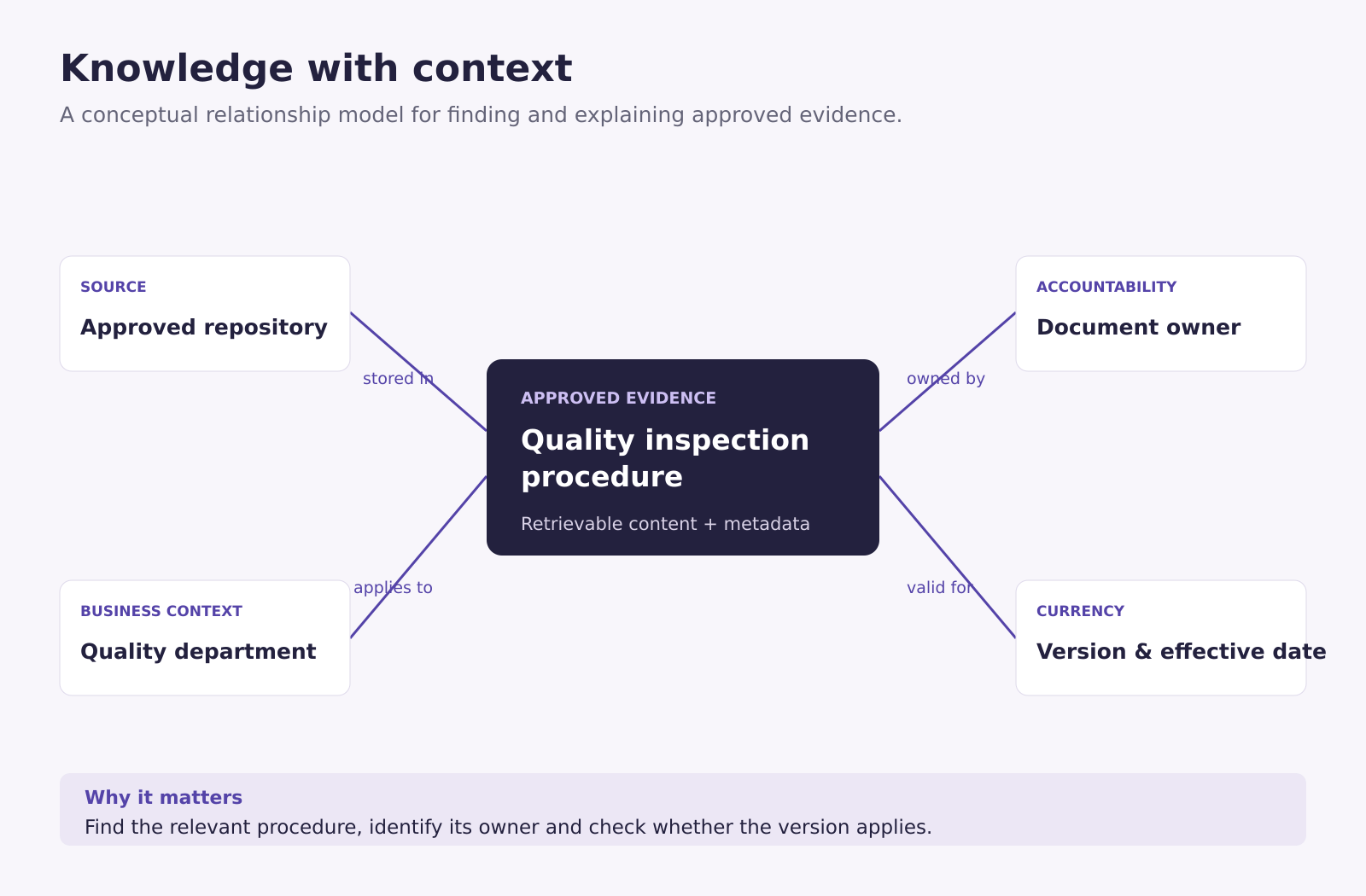
Connect the document to its business meaning.
A useful answer depends on more than matching words.
A quality procedure belongs to a department, has an accountable owner, lives in a repository and applies for a particular version or effective date. These relationships help teams understand why a source is relevant.
The wider enterprise roadmap
SAP, CRM and HR context. One governed experience.
The broader architecture separates document retrieval from structured system access. Business integrations require their own approved scope, connectors, permissions and validation.
The domain scenarios below belong to the wider integration roadmap. Each needs its own validation; the focused knowledge pilot remains read-only.
Understand the record and the rule.
Designed queries include purchase-order release status and invoice-block context, paired with approved policies where relevant.
Bring operational exceptions into focus.
Candidate scenarios include order delays, material shortages, stock availability and work-centre context through approved read tools.
Prepare for the next customer conversation.
Documented demonstration prompts cover account summaries, opportunities, cases and visit planning. Task creation needs separately authorised workflow controls.
Guide employees to the right information.
Candidate scenarios cover leave policies, calendars, onboarding guidance and training information, with role-based access and sensitive-data controls.
Every response should make clear
What is the source?
Who can see it?
What needs human approval?
These questions guide the experience from the first knowledge query to any future business-system action.
Governance is part of the experience
Trust is designed into the path.
- Identity and permission boundariesEntra ID sign-in, least-privilege access and tests that check users cannot retrieve unauthorised content.
- Read-only by defaultStructured access through approved APIs or curated views. No free-form chat-to-database execution.
- Separate answers from actionsFuture write operations require policy checks, approvals, audit references and business ownership.
- Make operations observableDefine index refresh monitoring, answer feedback, incident handling and support runbooks.
The delivery approach
A bounded pilot. Evidence before expansion.
Stage 01 / Define
Agree the foundation
Confirm business questions, source ownership, access boundaries, environment requirements and acceptance criteria.
Stage 02 / Validate
Prove the knowledge path
Build one approved source journey, test grounded responses and citations, then validate permissions with a limited user group.
Stage 03 / Decide
Expand through review
Use feedback, evaluation results and operational readiness to decide whether to add sources or controlled domain integrations.
The documented work
A structured foundation for delivery.
The project material connects business requirements with technical decisions, testing and operational responsibilities.
Business and agent architecture
Requirements, domain responsibilities, intent catalogue and routing patterns for a conversational enterprise interface.
Knowledge-agent implementation guide
Source onboarding, retrieval design, grounding rules, permission checks and a focused read-only pilot scope.
Environment and governance planning
Development and production separation, identity, monitoring, deployment controls and readiness checklists.
Use cases and evaluation planning
Business prompts, demonstration scenarios, UAT scripts and a staged roadmap for evaluating the approach.
Questions from enterprise teams
Plan the right starting point.
What does the knowledge copilot pilot include?
A scoped Microsoft Teams experience using Copilot Studio, Azure AI Search and Azure OpenAI to retrieve approved content and return answers with citations. The focused pilot is read-only.
Can the wider design connect SAP, Salesforce and HR platforms?
The broader blueprint includes these domains through approved tools and connectors. Each integration depends on system access, data ownership, licensing, security review and testing. The source material does not confirm a completed rollout across these systems.
How are unsupported answers and sensitive information handled?
The design calls for source-grounded answers, permission filtering, sensitive-data controls and an explicit fallback when approved evidence cannot be found. These controls must be implemented and tested for the chosen environment.
How should an organisation measure the pilot?
Agree a baseline and representative questions, then assess answer relevance, citation quality, access control, response time, user feedback and operational readiness. Treat improvement figures as targets until validated.
Your next enterprise AI decision
Choose one business question worth answering well.
Discuss your knowledge sources, system landscape and user needs with MetaDynamic. Define a practical pilot with clear scope, governance and evaluation.